What Is a Dialogue Coach in Film?
The voice is the last costume. Make it wrong and the audience notices before the first reel ends.
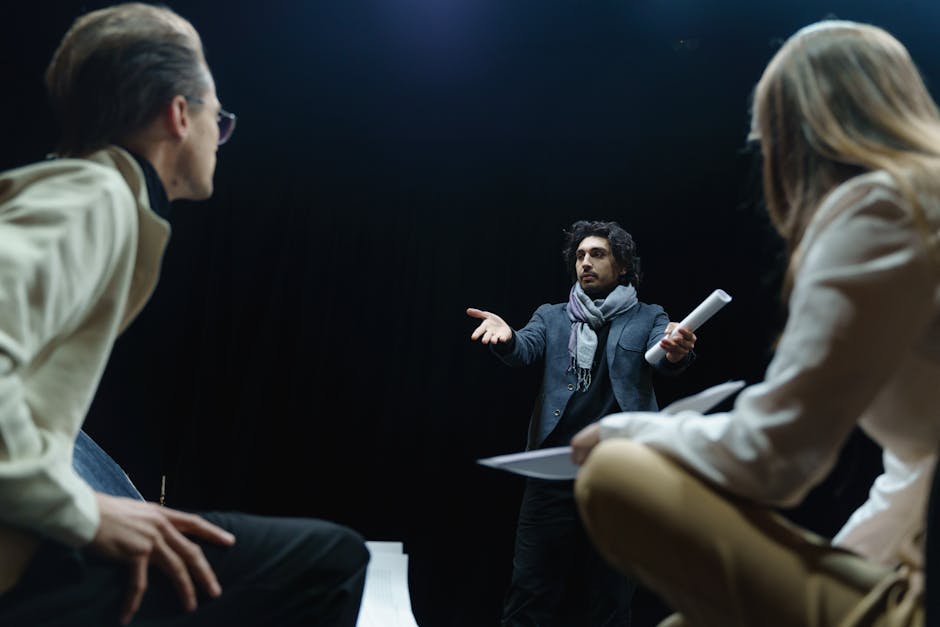
A dialogue coach — more precisely called a dialect coach in most professional contexts — is a technical advisor who works with actors to craft authentic voice and speech patterns for their characters. They’re responsible for making a West London accent believable on a Scottish actor, or ensuring an American performer’s Mandarin doesn’t pull the audience out of a period drama set in 1940s Shanghai.
The role lives in the intersection of linguistics, performance, and storytelling. A dialogue coach isn’t just a pronunciation corrector — they’re a collaborator in character design.
What does a dialogue coach do?
The Dialogue Coach’s Role on a Film Production
A dialogue coach’s work begins well before the cameras roll and can extend into post-production. Their scope varies considerably by production and by actor:
Pre-production:
- Research the target dialect — regional, historical, or social — using native speaker recordings, archival footage, and phonetic analysis
- Meet with the director to align on how authentic vs. textured the accent needs to be
- Sit in on auditions to assess which candidates can realistically achieve the required dialect
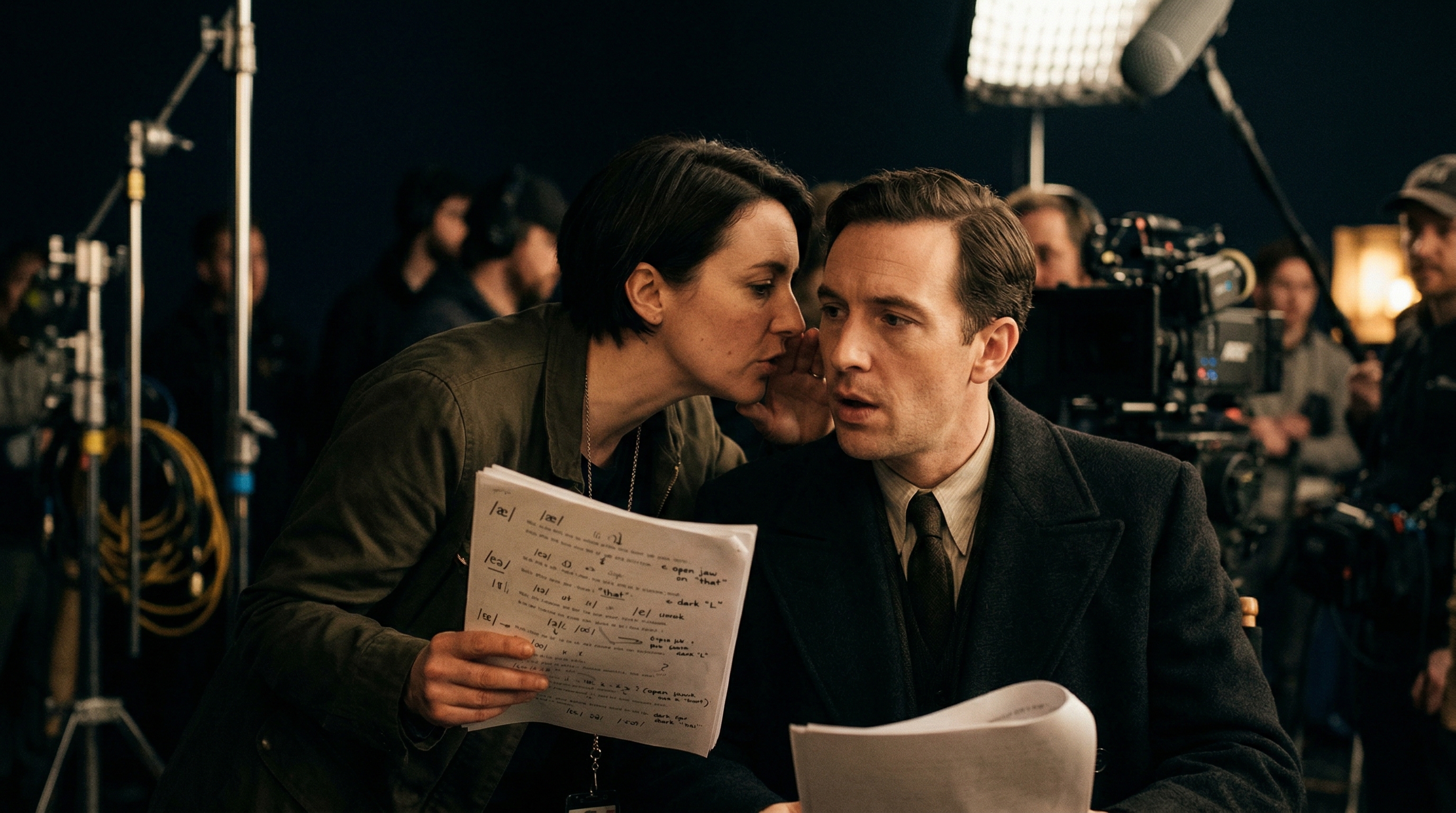
- Annotate scripts with phonetic markers and notes for the actor’s reference
- Run one-on-one coaching sessions and group workshops with ensemble casts
Production:
- Attend on-set rehearsals and shooting days to monitor consistency
- Stand behind the camera during takes, listening for dialect slippage
- Give immediate adjustments between takes — a specific vowel shift, a consonant placement
- Coordinate with the director and sound mixer when vocal issues arise
Post-production:
- Attend Additional Dialogue Replacement (ADR) sessions to maintain consistency when the actor re-records lines months after principal photography
- Monitor that a freshly recorded line matches the dialect established in the original performance
As Andrew Jack — dialect coach on Indiana Jones and the Last Crusade, Star Wars: The Force Awakens, and Star Wars: The Last Jedi — put it: “The makeup’s always right. The hair is right. The costume’s right. And so the voice needs to be right, too.”
Where does the dialogue coach appear in film credits?
Dialogue Coach Credits Placement in End Rolls
The credit typically reads “Dialogue Coach” — this is the conventional screen credit designation even though “dialect coach” is the more common industry term used day-to-day.
Placement in end credits:
- Appears in the body of the end crawl, typically in the production/below-the-line crew section
- Often grouped with other specialized coaching credits (acting coach, movement coach) or placed near the casting section
- On productions with multiple dialogue coaches — common when a film involves several different languages or accents — each coach is listed separately on individual lines
Standard credit format:
Dialogue Coach .................. SARAH MILLEROr, for multiple coaches:
Dialogue Coaches .................. SARAH MILLER
                                    DAVID CHEN
Opening credits: Dialogue coaches do not receive opening credits. Their credit is exclusively in the end roll.
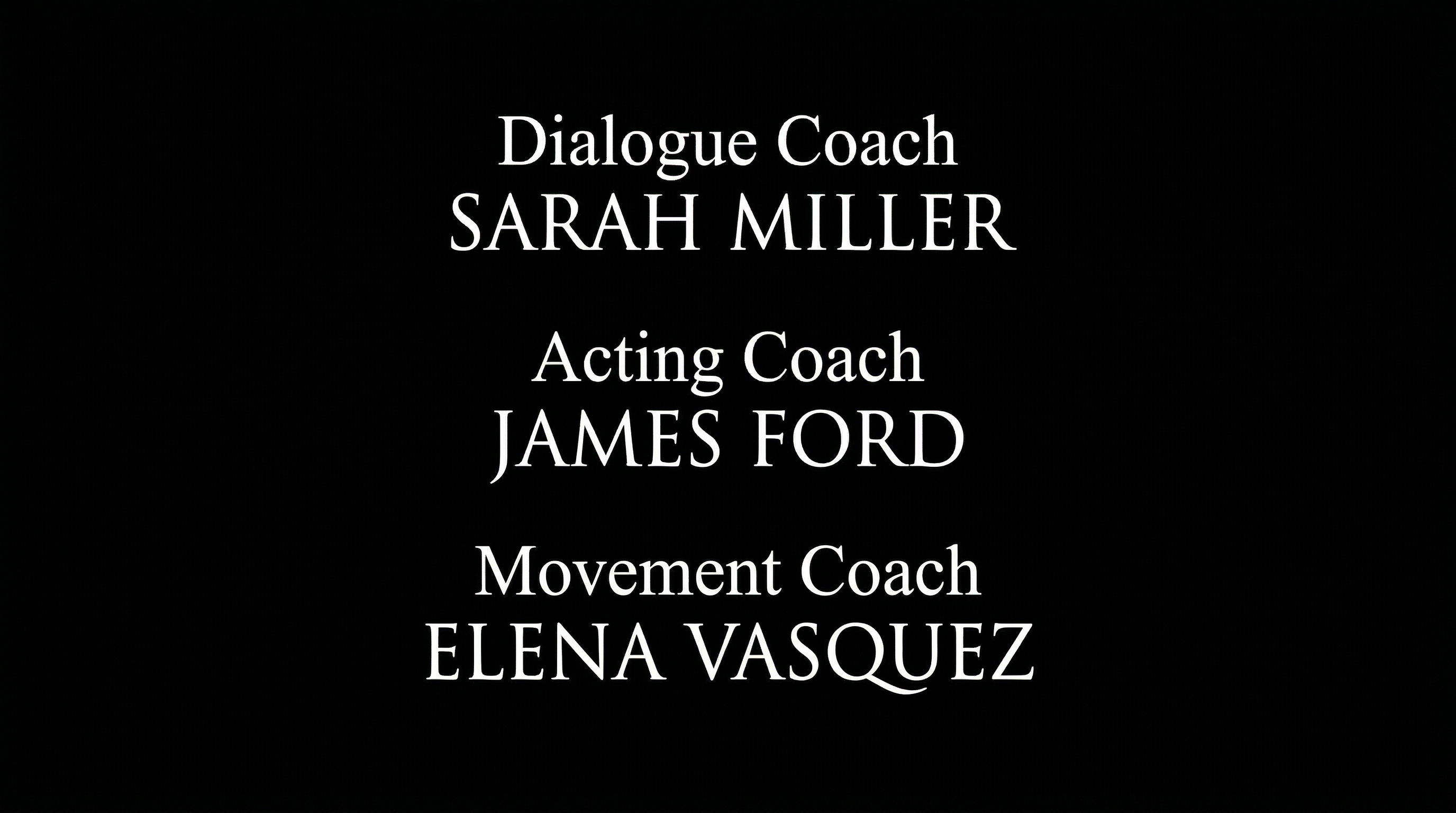
Single card vs. crawl: Always in the crawl — not a single card. This is not a card-level credit.
No IATSE collective bargaining agreement governs dialogue coach credits specifically. Credit placement is negotiated as part of the individual deal. On SAG-AFTRA productions, if the coach is also providing any services that fall under another union’s jurisdiction, separate agreements may apply.
How to credit a dialogue coach correctly
Crediting the Dialogue Coach vs. Dialect Coach
The naming distinction matters on the credit screen:
| Term Used On Set | Term Used in Credits |
|---|---|
| Dialect coach | Dialogue Coach |
| Voice coach | Dialogue Coach |
| Speech coach | Dialogue Coach |
| Accent coach | Dialogue Coach |
Always use “Dialogue Coach” in the end credits — it’s the established industry convention regardless of what the role was called during production. The exception: if the contract specifies a different credit designation, honor the contract.
If one person coached multiple languages or characters:
- Use “Dialogue Coach” (singular) if they handled all coaching
- Use “Dialogue Coaches” if multiple people shared the work
- Avoid invented titles like “Chief Dialect Supervisor” — stick to standard designations
If the same person also served as a language consultant: The practice varies. Some productions credit both roles separately on two lines; others credit the primary function only. When in doubt, check with the production attorney and honor the performer’s contract language.
Dialogue coach vs. acting coach
Dialogue Coach vs. Acting Coach: What’s the Difference?
These roles are often confused, especially on smaller productions where one person may do both:
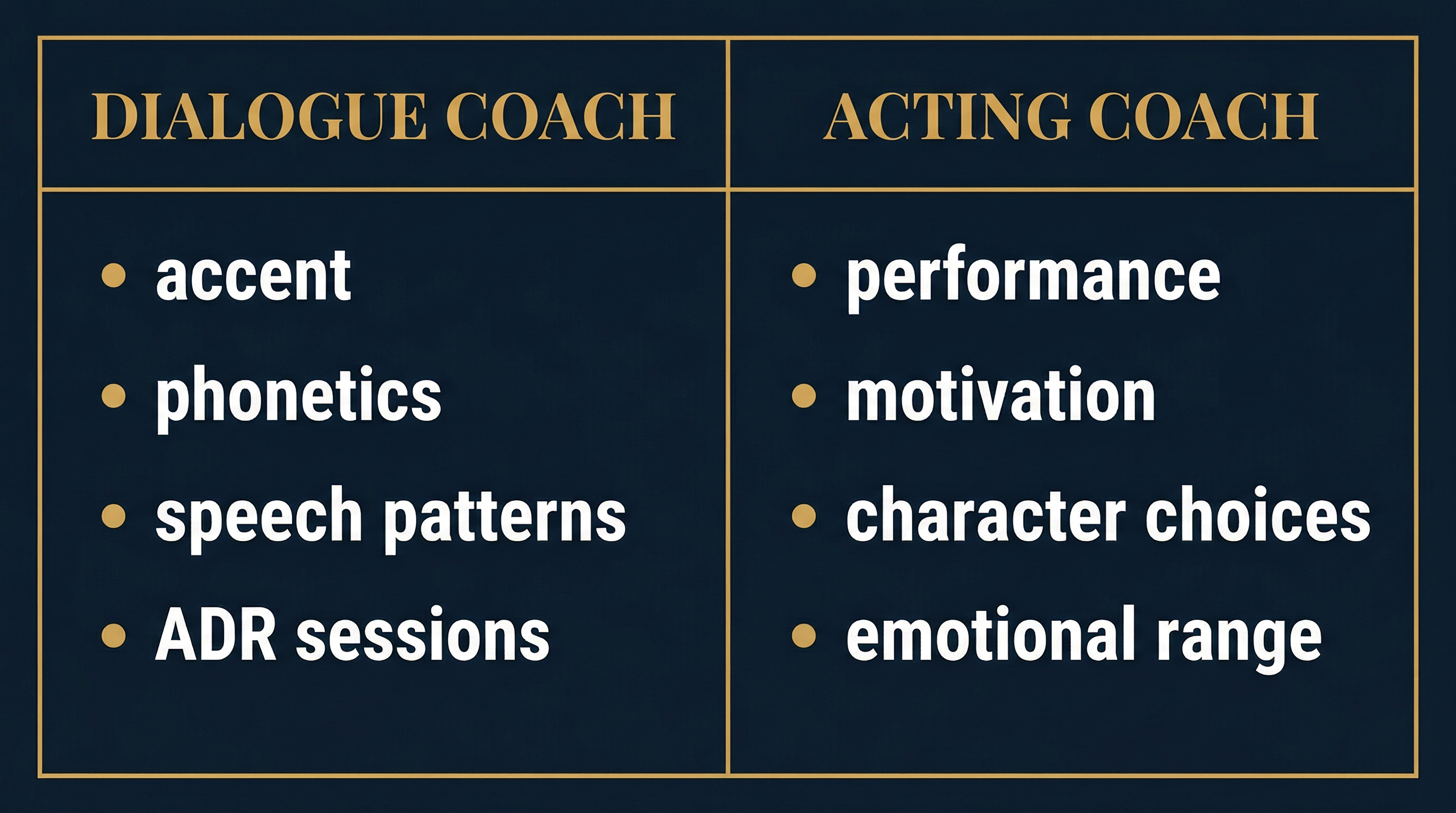
| Dialogue Coach | Acting Coach | |
|---|---|---|
| Focus | Voice, accent, speech patterns | Performance, motivation, character choices |
| On set | Monitors specific vocal elements | Broader performance feedback |
| Guild jurisdiction | None (direct hire) | None (direct hire) |
| Credit | ”Dialogue Coach" | "Acting Coach” |
| When hired | When accent/dialect work is required | When actors need performance support |
The credits reflect this distinction. A production that employed both roles lists them separately — you’ll see “Dialogue Coach” and “Acting Coach” as distinct lines in the crawl. Never merge these credits into a single line.
How much does a dialogue coach make?
Dialogue Coach Salary and Day Rates
Dialogue coaches are almost always freelance and negotiate individual rates per production. There’s no standard union scale for the role in the US.
Typical day rates (US, as of 2025):
- Low-budget/independent films: $400–$700/day
- Mid-range studio productions: $800–$1,500/day
- Major studio features (heavy accent work): $1,500–$3,000+/day
- Television: $500–$1,200/day depending on episode budget and recurring nature of engagement
Coaches who specialize in rare or highly technical dialects — historical accents, constructed languages, specific regional varieties — command rates at the upper end. Andrew Jack, for example, became one of the most sought-after dialect coaches in UK film and television, working on productions across four decades.
Prep work (pre-production coaching sessions) is typically billed separately from on-set days. Long-form productions with extensive ensemble cast work can result in months of steady employment.
Notable dialogue coaches in film history
Famous Dialect Coaches Who Shaped Film Performances
Andrew Jack (1944–2020) One of the most prolific British dialect coaches in film history. Credits include Indiana Jones and the Last Crusade, Braveheart, Star Wars: The Force Awakens, Star Wars: The Last Jedi, and dozens of others. Trained at the Central School of Speech and Drama; went freelance in 1978. Also designed constructed language dialects for major franchises.
Robert Hinkle Texas rodeo performer turned Hollywood dialect coach. Worked as a dialogue coach on Giant (1956) and Hud (1963), coaching the Texas vernacular for productions set in the American Southwest. Taught Rock Hudson and Paul Newman period-appropriate speech patterns.
Tim Monich New York–based dialect coach with credits spanning five decades, including The Silence of the Lambs, Philadelphia, Far from Heaven, and multiple Meryl Streep collaborations. Considered one of the defining figures in American film dialect coaching.
Sources & Further Reading
Official sources:
- Voice and Speech Trainers Association (VASTA) — the professional organization for dialect and speech coaches in North America
- Wikipedia: Dialect coach — overview of terminology, hiring practices, and professional societies
Further reading:
- Film Credits Format & Order Guide — full breakdown of how end credits are structured
- Guild Requirements for Film Credits — how union agreements affect credit placement
Create Accurate Credits with EndCreditsPro
A dialogue coach’s credit is one of dozens of below-the-line roles that need to be formatted correctly and placed in the right order. EndCreditsPro generates broadcast-ready end credits with correct role hierarchy automatically — so “Dialogue Coach” ends up where it belongs, formatted the way broadcasters expect.
Generate guild-compliant credits in minutes →
Related roles: Casting Director · ADR Mixer · Production Sound Mixer · Hair Stylist · Film Crew Roles Hub