What Is a Props Master in Film?
Every object an actor touches, reads, fires, or bleeds on — the props master put it there. Miss one, and the scene stops.
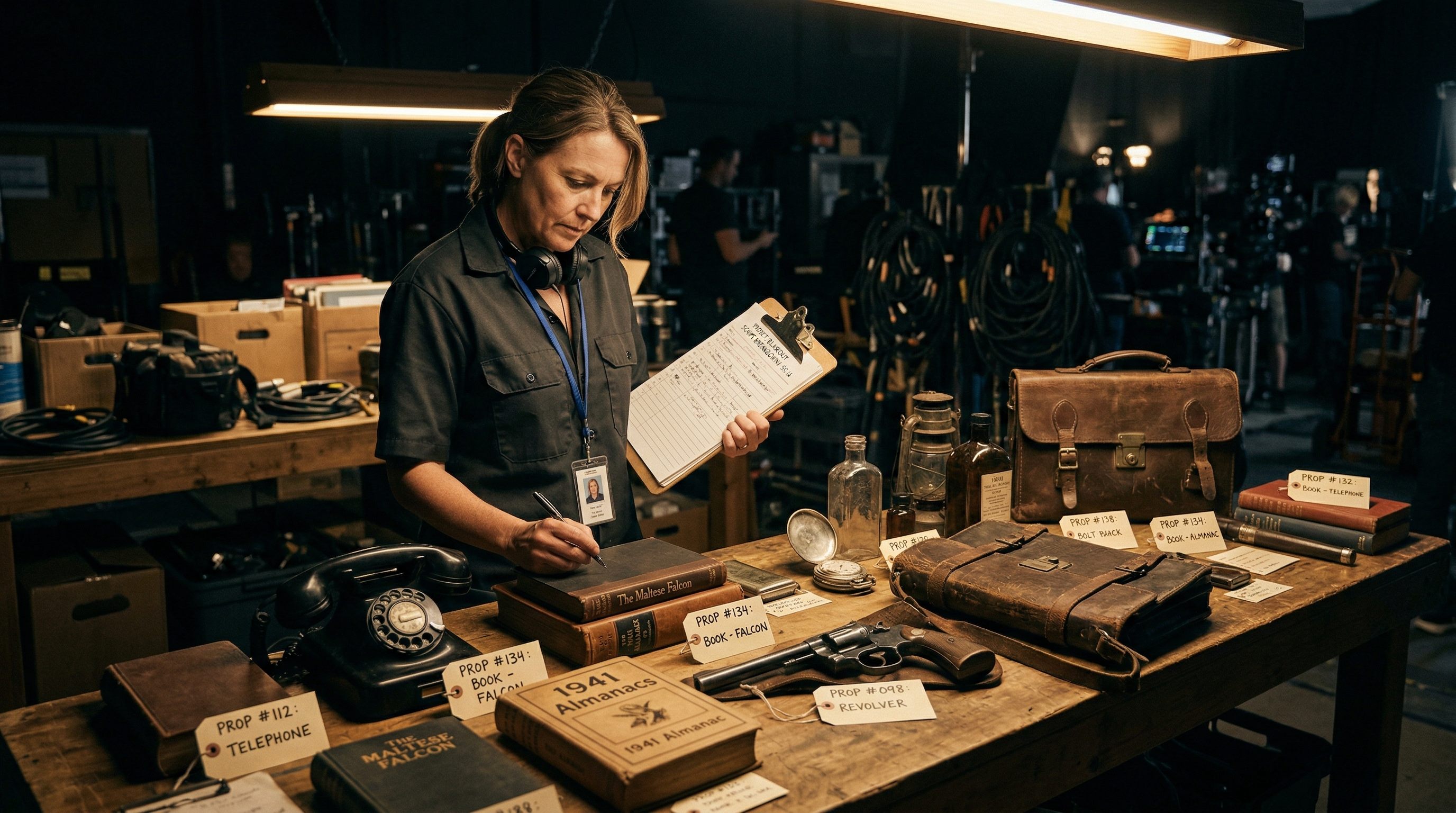
The props master (also called property master) is the head of the props department, responsible for the design, selection, acquisition, placement, and disposal of every prop required for a production. That covers anything an actor physically interacts with on screen: the pen they write with, the phone they answer, the gun they draw, the newspaper they read.
Props masters sit within the art department and work directly under the production designer. On union productions, they are represented by IATSE Local 44 — Affiliated Property Craftspersons.
What does a props master do?
What Does a Props Master Do?
The props master’s work runs across all three phases of production.
Pre-production:
- Reads the script and creates a props breakdown — a scene-by-scene inventory of every prop, including which actor uses it and when
- Researches period-appropriate or culturally specific props for historical or location-based productions
- Budgets and sources props: purchasing, renting from prop houses, or commissioning custom fabrication
- Collaborates with the director and production designer on aesthetic and stylistic choices
- Coordinates with the art director, set decorator, wardrobe department, and special effects on overlapping items
Production:
- Ensures each prop is on set and in the correct condition at the start of every scene
- Maintains continuity with the script supervisor — if the character’s lighter appears on the left side of the table in Scene 12, it stays there through Scene 14
- Manages the props team: assistant property master(s), props buyers, props builders, and set props persons
- Oversees firearms safety and licensing for weapon props; scuba certification is required for underwater work involving props
- Assumes responsibility for set dressing items the moment an actor picks them up — at that point, the set decorator’s jurisdiction ends and the props master’s begins
Post-production:
- Oversees the return, sale, or disposal of all rented and purchased props
- Reconciles the props budget
The props department’s jurisdiction also extends to:
- Live animals and food styling (on productions without dedicated specialists)
- Vehicle detailing: license plates, light bars, signage
- Non-motorized transportation: bicycles, wagons, carts
- Stunt dummies and breakaway props
- All male actor jewelry, watches, and eyeglasses (female actor jewelry is handled by wardrobe unless it’s plot-critical)
Props master salary
Props Master Salary & Day Rates
On union productions (IATSE signatory), rates are set by contract. As of 2025–2026:
| Market | Compensation |
|---|---|
| U.S. average annual salary | ~$101,000–$107,000 |
| U.S. hourly rate (union) | ~$40–$49/hour |
| Non-union / low-budget day rate | $400–$700/day |
Rates vary significantly by market, production type, and budget. A props master on a studio feature commands different rates than one on a regional commercial. IATSE Local 44’s Basic Agreement with the AMPTP sets the floor for major studio productions.
Props master vs set decorator
Props Master vs. Set Decorator: Where the Line Is
This is the most common confusion in the art department. The distinction is clean:
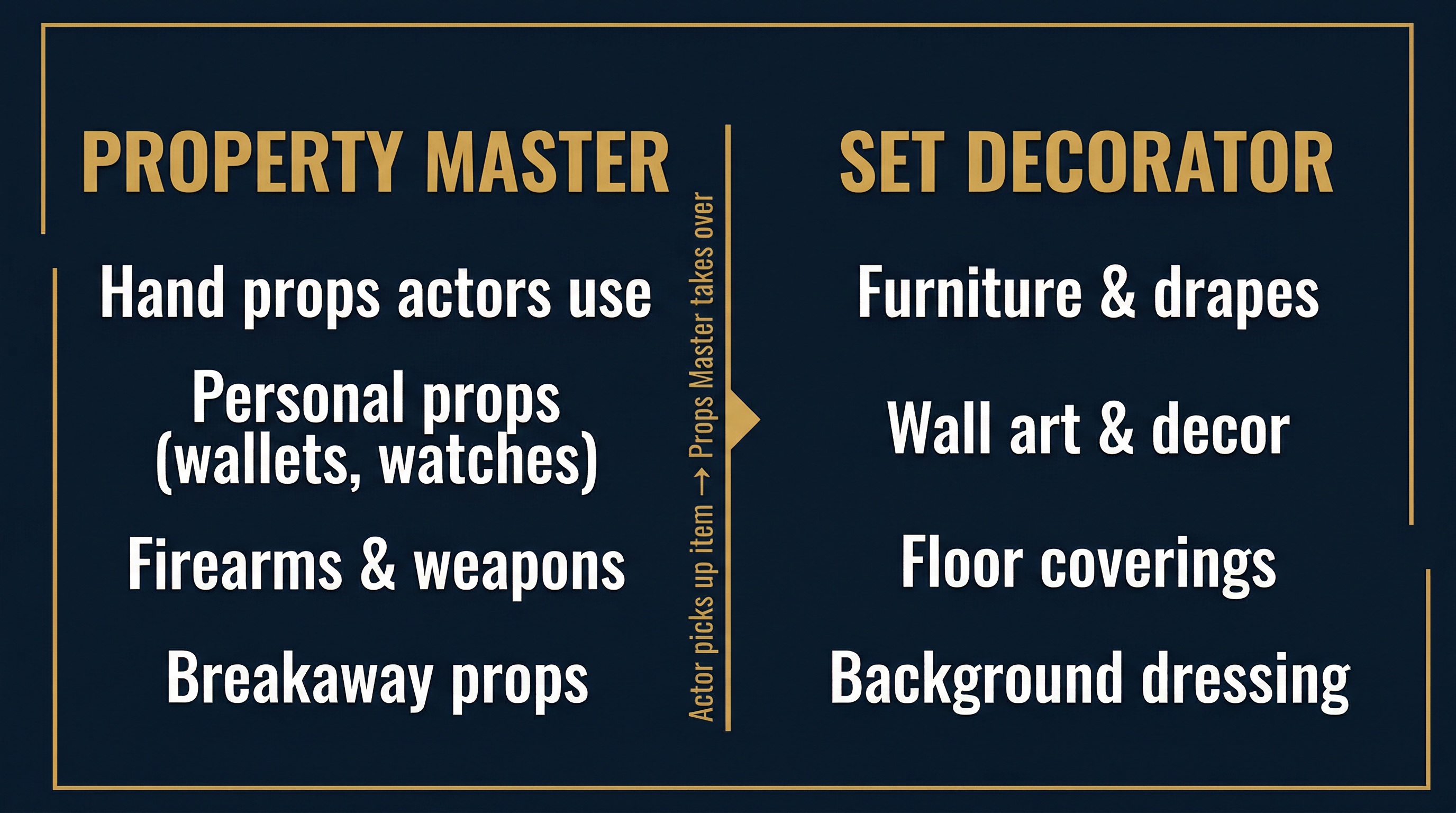
- Props master — controls objects that actors physically use or interact with on camera
- Set decorator — controls the visual environment: furniture, drapes, wall art, floor coverings, anything that creates the world but isn’t in an actor’s hands
The practical handoff point: the moment an actor picks up a set dressing item (say, a picture frame from the mantle), that item becomes a prop for the duration of the scene. The props master takes responsibility for it. When the scene ends and the frame goes back on the shelf, the set decorator’s territory resumes.
Both positions report to the production designer. They coordinate continuously — props and set dressing share the same visual world and need to match.
Where does the props master appear in film credits?
Where the Props Master Appears in Film Credits
The props master does not appear in opening titles. Their credit runs in the end crawl, within the art department section.
Standard end credit placement:
The art department block in a feature film typically runs in this order:
- Production Designer
- Art Director
- Set Decorator
- Property Master
- Assistant Property Master
- Props Buyer / Props Builder
- Set Dresser(s) / Lead Person / On-Set Dresser
The props master earns a named card — their name appears on screen with their title. On larger productions, the entire props team may be listed in a grouped department block.
Credit format in the scroll:
Property Master ............ JANE DOE
Assistant Property Master .. JOHN SMITH
Or in a two-column department layout:
PROPERTY DEPARTMENT
Property Master          Jane Doe
Assistant Property Master  John Smith
Props Buyer              Alex Rivera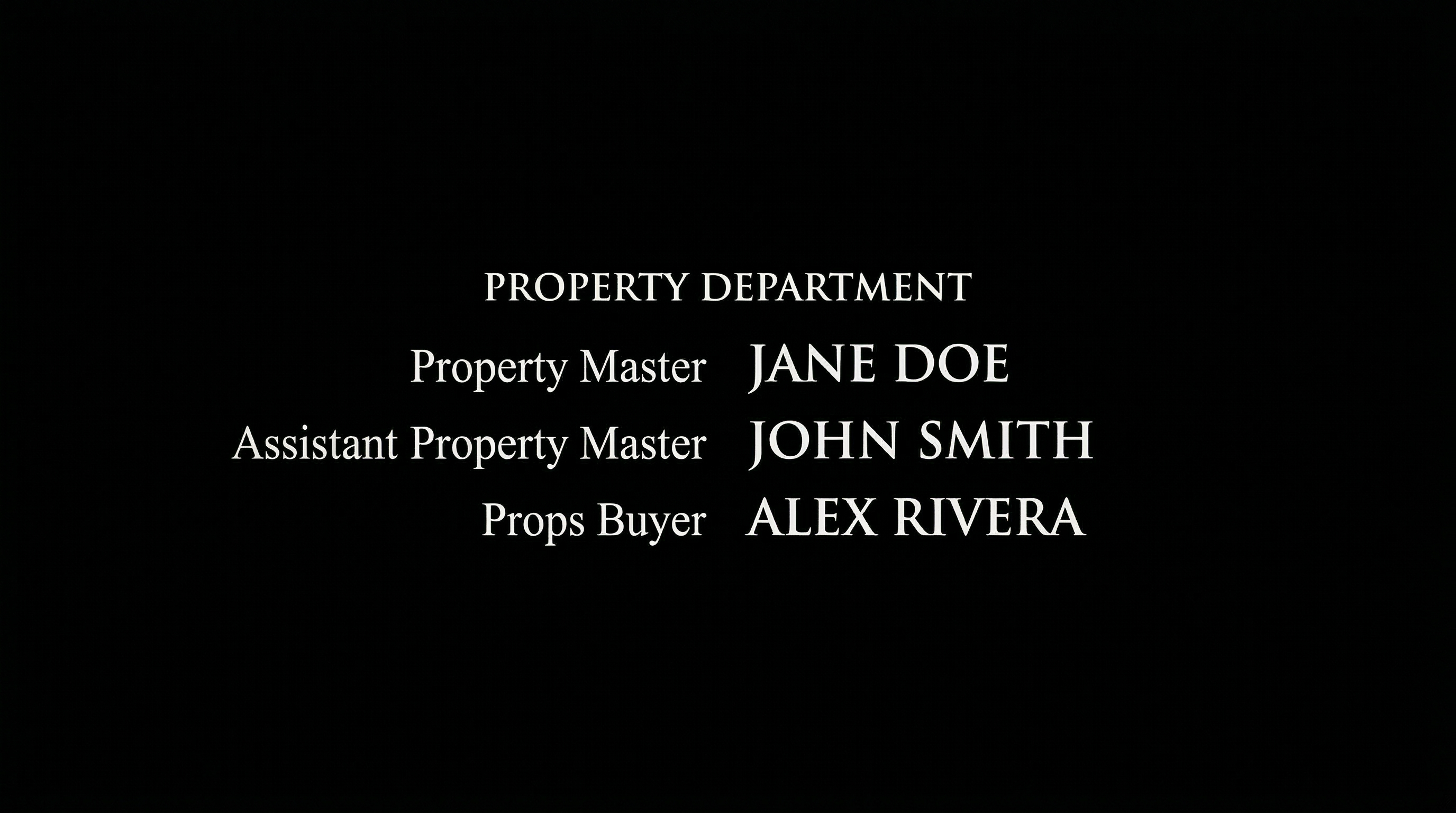
Guild considerations: IATSE Local 44 agreements specify minimum billing requirements for union productions. The Property Master is guaranteed a credit — the title used is “Property Master” (not “Props Master” or “Prop Master”). Most productions follow this convention in credits even if they use “props master” colloquially on set.
On television, the props master typically appears in the end card of each episode, often in a grouped art department credit block.
How to credit a props master correctly
How to Credit a Props Master Correctly
Follow these conventions for accurate, guild-compliant credits:
Title format: Use “Property Master” — this is the official IATSE Local 44 designation. “Props Master” is widely used on set and in conversation, but “Property Master” is standard in formal credits.
Single production, single props master: Straightforward — one name, one title.
Multiple props masters (e.g., different shooting units): Credit each by unit:
Property Master (Main Unit)   Jane Doe
Property Master (Second Unit) Alex Rivera
If one person served as both props master and art director (common on micro-budget productions): List the title that carries more billing weight, or list both:
Art Director / Property Master Jane DoeWhat NOT to do:
- Don’t abbreviate to “Prop Master” in formal credits
- Don’t omit the props master from credits — on IATSE productions, this is a contractual obligation
- Don’t list the props master above the set decorator unless production-specific billing agreements specify otherwise
What are the categories of film props?
The Three Categories of Film Props
Every prop falls into one of three categories:
| Type | Definition | Examples |
|---|---|---|
| Hand props | Items actors carry, hold, or use directly | Guns, phones, briefcases, pens, cigarettes |
| Set props | Items on set that may or may not be handled | Furniture the actor moves, books on a shelf being browsed |
| Personal props | Items belonging to or identifying a character | Wallets, watches, glasses, jewelry (plot-critical) |
Breakaway props — items designed to shatter, burn, or deform safely on camera — are built or sourced by the props department and often require coordination with the special effects team.
Notable props masters in film history
Notable Props Masters in Film History

Russell Bobbitt — props master for the Marvel Cinematic Universe across more than 20 films. Bobbitt’s department built Captain America’s shield, Thor’s hammer Mjolnir, and Iron Man’s Arc Reactor prototypes. His work on Iron Man (2008) through the Avengers cycle established the MCU’s visual continuity across interconnected stories. He received the Humanitarian Award at the inaugural MacGuffin Awards.
Emily Ferry — one of the most decorated property masters in Hollywood history. Ferry’s credits include The Right Stuff, Alien: Resurrection, How the Grinch Stole Christmas, and Memoirs of a Geisha. She was the first female property master in Hollywood film and television — a distinction that earned her a Lifetime Achievement Award at the MacGuffin Awards.
How to become a props master
How to Become a Props Master
The standard career path on union productions runs through IATSE Local 44:
- Start as a props person or props assistant — working on set under an established property master
- Advance to assistant property master — 2,500 logged work hours with IATSE signatory employers is the formal requirement to be recognized at this level
- Join the Local 44 roster — requires 30 qualifying days of union work registered with the Contract Services Administration Trust Fund (CSATF) to get on the Industry Experience Roster (IER)
- Qualify as property master — either through 2,500 hours as an assistant property master plus a script breakdown/budgeting test, or through 30 days as a property master on organized productions
Non-union pathways exist through commercials, music videos, and low-budget features. Many props masters also come from prop houses, theater, or fabrication backgrounds — the craft values practical skills (sourcing, building, budgeting) over formal education.
Required skills:
- Script breakdown and budget management
- Deep knowledge of historical periods, cultures, and material authenticity
- Firearms licensing (required by IATSE) and safe handling procedures
- Negotiation and vendor relationships (prop houses, rental suppliers, fabricators)
- Logistics and inventory management across a shooting schedule
Sources & Further Reading
- IATSE Local 44 — Property Master Craft Description
- Property Masters Guild
- Property Master — Wikipedia
Create Professional End Credits with EndCreditsPro
The props department — property master, assistant property masters, props buyers, and props crew — needs to appear correctly in your end credits. EndCreditsPro auto-formats your crew list by department, applies the right hierarchy, and generates broadcast-ready end credits in minutes. No manual formatting, no missed credits.
Generate guild-compliant credits now
See also: Film Crew Roles · Production Designer · Set Decorator · Art Director · Complete Guide to Film Credits · Film Credits Format & Order Guide