What Is an Orchestrator in Film?
Hans Zimmer’s score for Interstellar lists six orchestrators in the end crawl. Without them, the composer’s sketches never become the pages the London musicians read on the scoring stage.
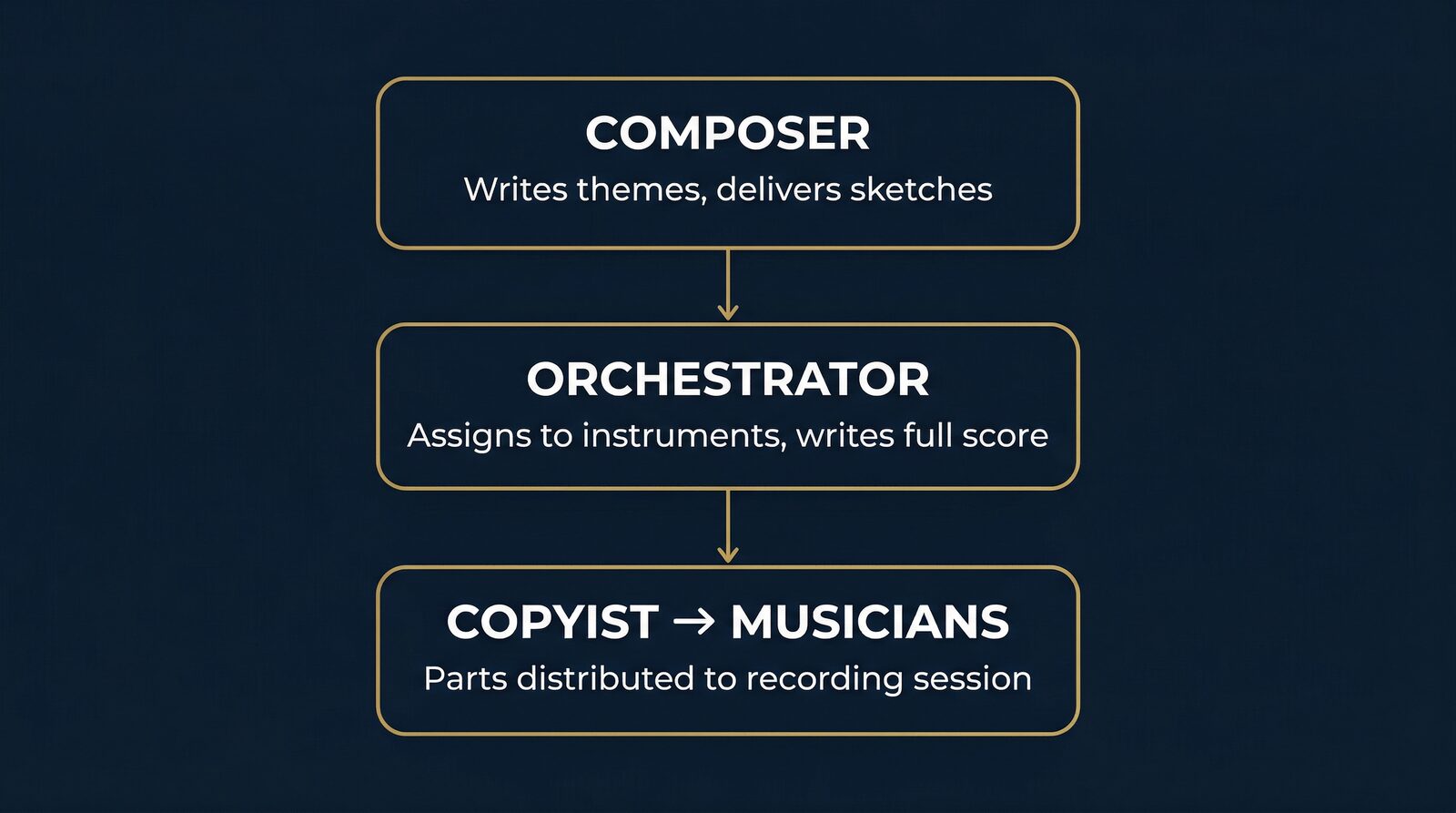
An orchestrator is the music department professional who transforms a film composer’s sketches — often detailed MIDI mockups or rough piano notation — into complete, instrument-by-instrument scores ready for live musicians to perform. They sit between the composer’s creative vision and the recording session, translating intent into a format the orchestra can execute.
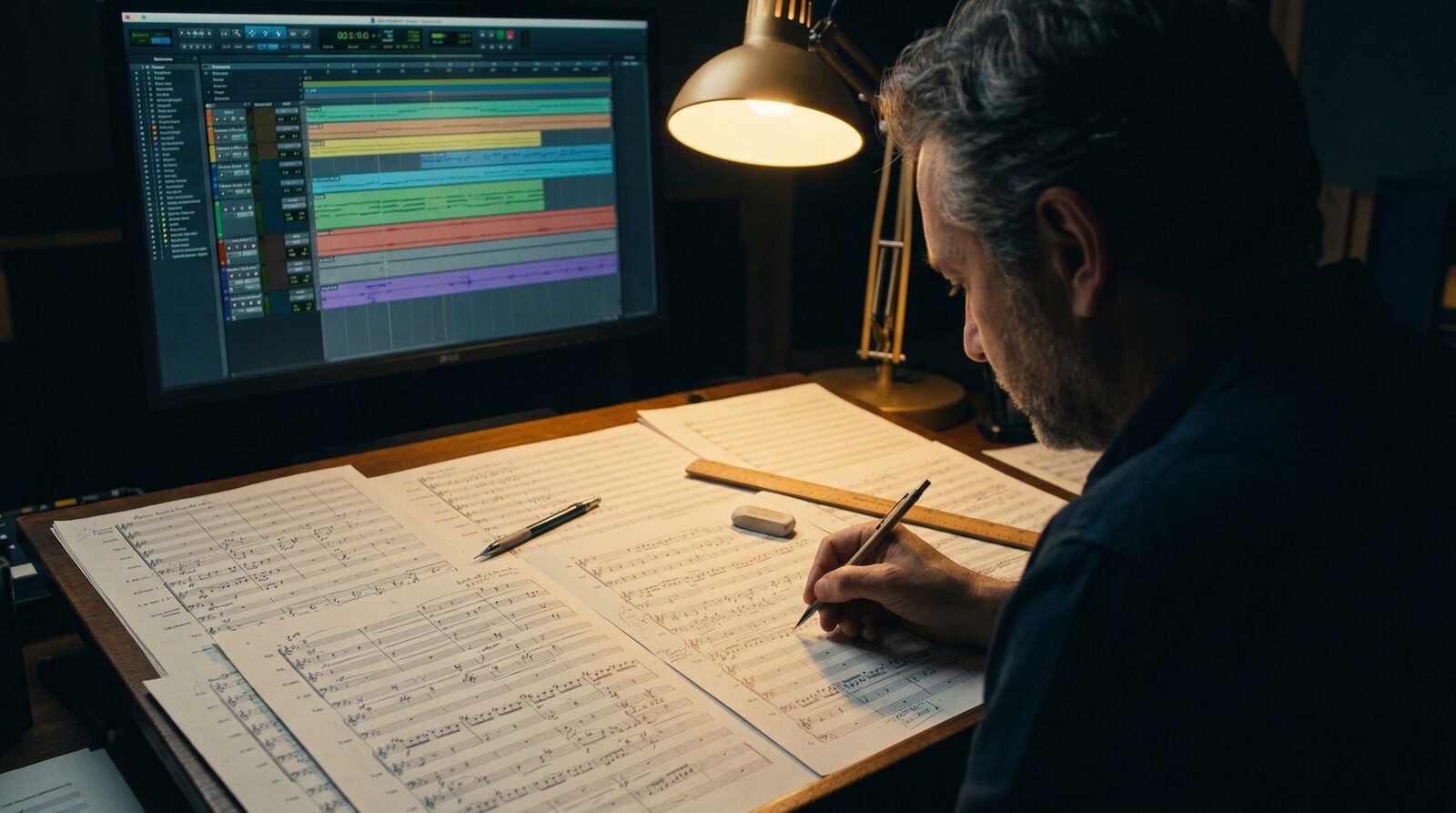
On major studio productions, the composer and orchestrator are distinct roles. The composer writes the themes, establishes the harmonic language, and delivers sketches. The orchestrator assigns notes to specific instruments, handles doublings, writes idiomatic passages for each section, and produces the individual parts that go on every music stand on the scoring stage.
Orchestrators work across film, television, and streaming. They are classified under the American Federation of Musicians (AFM) on union productions.
What does an orchestrator do?
The Orchestrator’s Role in Film Production
The orchestrator’s job begins when the composer delivers sketches and ends when copyists distribute the finished parts to musicians. In practice, that window is often measured in days, not weeks — scoring sessions for major productions routinely run up to seven days behind the original schedule.
Core responsibilities:
- Expanding composer sketches — Taking multi-track MIDI mockups or annotated piano scores and writing out each instrumental part in full notation
- Instrumentation decisions — Determining which instruments carry the melody, which provide harmonic support, and how to balance the orchestra for the required sound
- Idiomatic writing — Adapting passages to the physical reality of live instruments (breathing patterns for wind players, bow direction and string crossings for strings, range limitations for brass)
- Score reading at sessions — Following the full score during recording to catch errors, flag intonation issues, and communicate with the conductor
- Last-minute revisions — Adjusting passages when the composer or director requests changes after the musicians are already in the booth
- Problem-solving notation — Handling sections where the synthesizer demo contains sounds that don’t translate directly to live instruments
On television productions, orchestrators often function as MIDI orchestrators as well — creating high-quality virtual instrument mockups when live orchestra budget isn’t available. This is particularly common in episodic drama and animation.
Modern Hollywood composers like Tom Holkenborg (Junkie XL) write detailed instrument-level MIDI templates — each violin section, viola section, and brass instrument on its own track — giving orchestrators a precise roadmap rather than a sparse sketch. The orchestrator’s job in this model is as much music copying and notation as creative instrumentation.
Who the orchestrator works with:
| Role | Relationship |
|---|---|
| Composer | Direct supervisor; delivers sketches and gives notes |
| Music Copyist | Downstream; receives finished orchestrations to extract individual parts |
| Music Contractor | Manages musicians and communicates scheduling with the orchestrator |
| Conductor | Works alongside at recording sessions |
| Music Editor | Handles sync and editing of recorded sessions; separate role |
Orchestrator film credits
Where the Orchestrator Appears in End Credits
Orchestrators appear in the music section of the end credit crawl. On major studio productions, this section typically runs immediately after the main below-the-line technical credits and before or alongside the “Special Thanks” section.
The music credits hierarchy in end credits typically runs:
- Original Score by (opening credits and end credits)
- Music Supervisor (end credits)
- Score Produced by or Additional Music by (end credits)
- Orchestrations by (end credits)
- Additional Orchestrations by (end credits, if applicable)
- Music Copyists (end credits)
- Music Preparation (end credits)
- Score Recorded at (end credits)
The “Orchestrations by” credit appears as a shared scroll card — multiple names listed under a single heading. On productions with large orchestration teams (typically superhero films or large-scale epics), six to ten names under “Orchestrations by” is standard.
Opening Credits: Orchestrators do not receive opening title cards. Opening credits are reserved for the composer credit (“Music by”) and occasionally the music supervisor on music-driven productions. Individual orchestrators appear only in the end crawl, regardless of their contribution.
Card format — single orchestrator:
Orchestrations by
PETE ANTHONY
Card format — orchestration team:
Orchestrations by
PETE ANTHONY    BRAD DECHTER
BRUCE FOWLER    WALTER FOWLER
ALEX ILES       STEVE BARTEK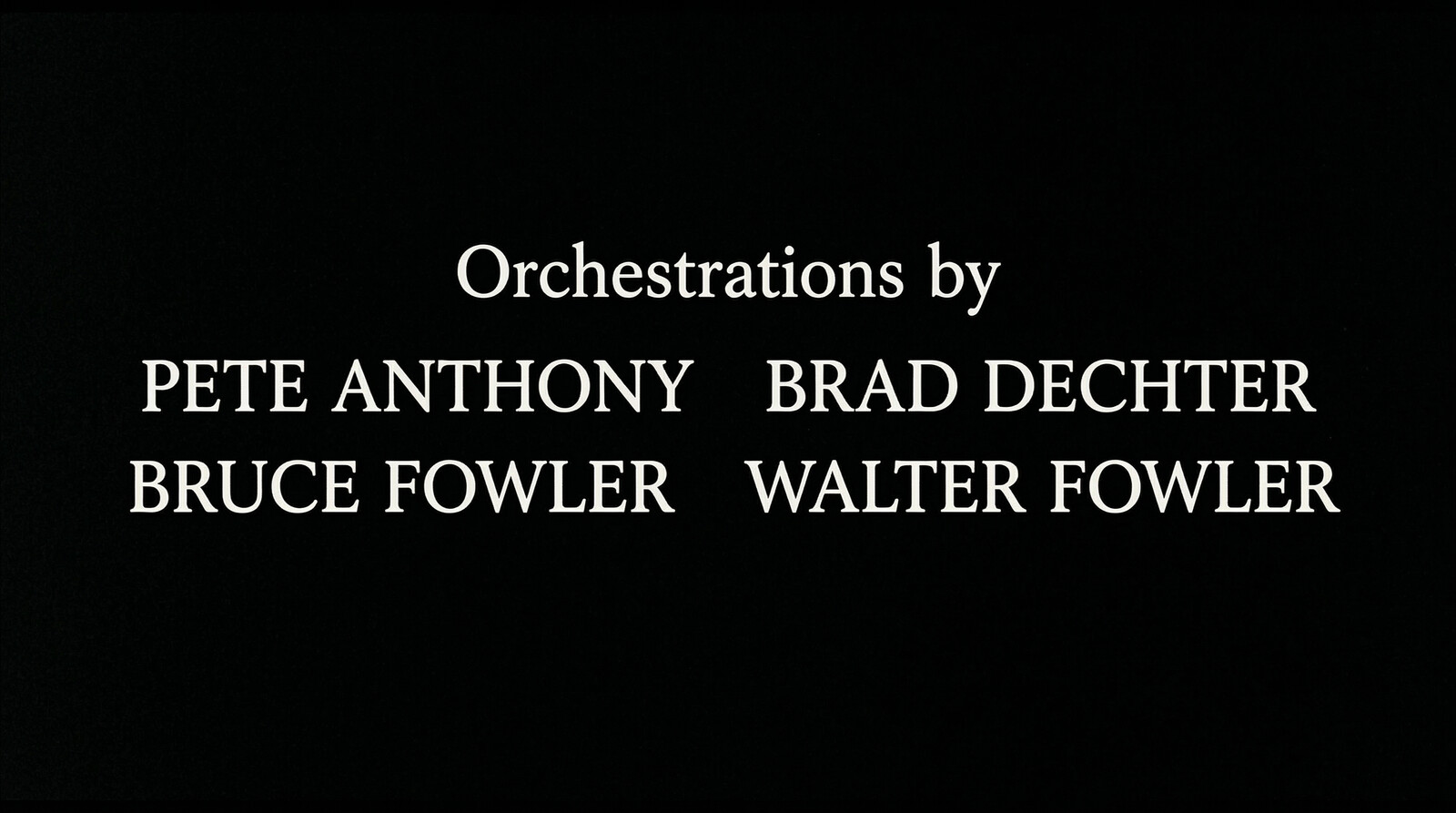
Additional orchestrators — used when a composer brings in specialists for specific sequences — appear under a separate “Additional Orchestrations by” heading, placed immediately after the main orchestrations credit.
How to credit an orchestrator correctly
Credit Title, Format, and Common Variations
The standard credit title is “Orchestrations by” — not “Orchestrator,” not “Orchestrated by.” The plural “Orchestrations” is used even when only one person performed the work.
| Credit Title | When to Use |
|---|---|
| Orchestrations by | Standard credit for the primary orchestrator(s) |
| Additional Orchestrations by | Secondary orchestrators brought in for specific cues or sequences |
| MIDI Orchestrations by | Used on productions where the orchestration was produced entirely in-sample format without live orchestra |
| Orchestrator | Used in crew lists and call sheets, not in screen credits |
Common formatting errors to avoid:
- “Orchestrated by” — incorrect; the convention is “Orchestrations by”
- Listing under “Music Department” without a specific heading — orchestrators receive a named heading, not a generic department block
- Omitting orchestrators entirely — on AFM union productions, orchestration credits are contractually required
AFM considerations: The American Federation of Musicians covers music preparation, including orchestration, on major studio productions. Under AFM agreements, orchestrators who are members must receive credit if their work appears in the final cut’s score. The specific language in most AFM-affiliated productions mirrors the credit format used by the major studios: “Orchestrations by” followed by names.
If one person served as both composer and orchestrator — which happens frequently on lower-budget productions — the practice varies. Some productions omit the orchestrations credit and list only “Music by.” Others include both a “Music by” and “Orchestrations by” credit pointing to the same person. Neither is technically incorrect; the cleaner convention is to omit “Orchestrations by” when the composer self-orchestrated.
Orchestrator vs. film composer
Where Composing Ends and Orchestrating Begins
The boundary between composer and orchestrator varies by production and by the specific composer’s working method. There is no single industry definition.
| Composer | Orchestrator | |
|---|---|---|
| Creative function | Writes themes, melody, harmony, rhythm | Assigns notes to instruments; handles idiomatic writing |
| Delivers | Sketches (MIDI mockup, piano score, or annotated notation) | Complete orchestral score and MIDI stems |
| Screen credit | ”Music by” or “Original Score by" | "Orchestrations by” |
| Opens credits? | Yes — typically a single card | No |
| Guild/Union | AFM (composers typically handle their own agreements) | AFM |
| On-set role | May or may not attend sessions | Attends scoring sessions as score reader or co-conductor |
The composer-orchestrator relationship is one of the most misunderstood in the music department. On productions where the composer is a strong orchestrator — Bernard Herrmann, Ennio Morricone, Jerry Goldsmith — the same person may receive both credits or simply “Music by.” On productions with aggressive delivery schedules — virtually all MCU and DCEU films — the composer writes sketches and orchestrators handle the full scoring, making the orchestration credit substantive and visible.
The music editor is a separate role entirely: they handle the synchronization, editing, and assembly of recorded music to picture, and they do not overlap with orchestration.
Notable orchestrators in film history
Three Orchestrators Who Defined the Hollywood Sound
Herbert Spencer — Worked with John Williams on Star Wars (1977), Raiders of the Lost Ark (1981), and dozens of major Hollywood productions. Spencer was among the first generation of orchestrators who shaped the modern studio orchestration model, translating Williams’ piano sketches into the full orchestral texture that became synonymous with blockbuster scoring.
Conrad Pope — Long-time orchestrator for John Williams, James Horner, and Alexandre Desplat. His credits include Schindler’s List, Titanic, The English Patient, and Harry Potter and the Sorcerer’s Stone. Pope is also a respected conductor who leads recording sessions when the primary composer is unavailable.
Pete Anthony — Orchestrator and conductor for Hans Zimmer, Klaus Badelt, and other Remote Control Productions composers. Anthony’s credits include Pirates of the Caribbean, The Dark Knight, and Man of Steel. He has conducted the live orchestra on hundreds of major Hollywood productions, making him one of the most recorded orchestrators working in the industry.
Sources & Further Reading
- Orchestrator (Film and TV) — Berklee College of Music
- Film Credits Format & Order Guide — EndCreditsPro
- American Federation of Musicians — AFM official site
Recommended Videos
Create Professional Credits with EndCreditsPro
Format music department credits — from composer through orchestration teams — with correct hierarchy and the right heading titles. Generate broadcast-ready end credits with EndCreditsPro or browse our film crew roles guide.