What Is a Dolly Grip in Film?
The camera operator frames the shot. The dolly grip decides whether it actually moves. Every tracking shot, every push-in, every crane-to-dolly transition — none of it happens without the grip at the handles.
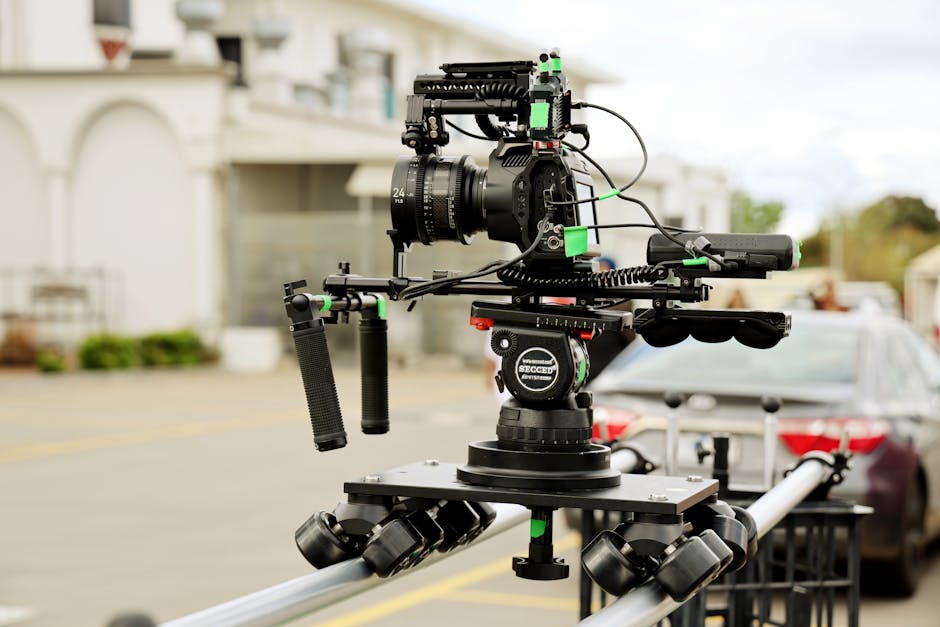
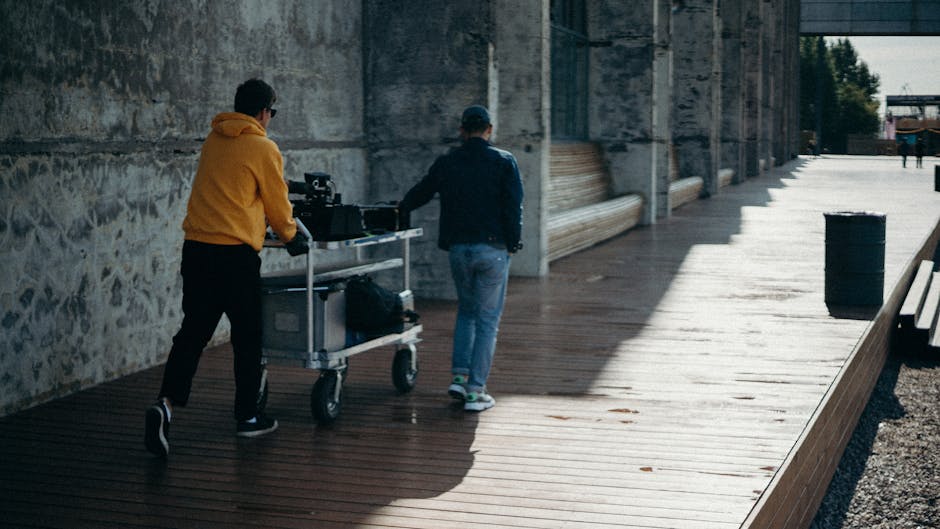
A dolly grip is the dedicated technician responsible for operating the camera dolly: the wheeled platform that carries the camera, the camera operator, and in many configurations the 1st Assistant Camera (AC) through every moving shot. The dolly grip lays and levels the track, mounts the dolly, and physically pushes or pulls it on cue — with timing precise enough to keep focus marks valid.
The role sits within the grip department, which is separate from the electrical department. The dolly grip reports directly to the Key Grip, who in turn reports to the Director of Photography (DP). On large features, the grip department also includes a Best Boy Grip and a rigging crew. The dolly grip is the specialist within that department — focused entirely on camera movement.
What does a dolly grip do?
Responsibilities of the Dolly Grip on Set
The job spans far more than pushing a cart. A working dolly grip needs mechanical aptitude, spatial awareness, and the ability to execute repeatable, identical moves on every take.
Pre-production:
- Reviewing the shot list and storyboards with the Key Grip and DP to understand camera movement requirements
- Selecting the right dolly for each production: Chapman/Leonard Hybrid, Fisher 10, Panther, Tulip, or a Doorway Dolly for tight interiors
- Assessing locations for floor type, levelness, and whether track will be required or if the dolly can run on floored surfaces
On-set duties:
- Laying and leveling dolly track — a process that requires surveying the path, shimming each section, and confirming the dolly rides without vibration
- Mounting the camera head (typically a fluid head or remote head) to the dolly column, adjusting height and angle with the camera operator and DP
- Coordinating movement timing with the 1st AC: the dolly grip’s lateral speed directly affects how the AC racks focus — a late push ruins a critical mark
- Executing moves on the director’s or DP’s mark, matching the exact same speed and arc across multiple takes
- Rigging the dolly arm (doorway dolly or Fisher boom arm) for canted angles, high-hat moves, and low-mode configurations
- Maintaining and cleaning the dolly throughout the shooting day — bearings, wheels, and the column mechanism must be silent
Key equipment the dolly grip works with:
| Equipment | Purpose |
|---|---|
| Chapman/Leonard Hybrid IV | Industry-standard feature dolly, hydraulic or pneumatic column |
| Fisher 10 / Fisher 11 | Common on TV episodics and commercials |
| Panther Dolly | Frequent choice for European co-productions |
| Tulip Dolly / Doorway Dolly | Tight spaces, narrow corridor shots |
| Curved and straight track | Smooth lateral and curved moves |
| Speedrail / pipe and fittings | Rigging custom track configurations |
| Dance floor panels | Rubber-coated platform for doorway dolly shots without track |
What is a dolly grip salary?
Dolly Grip Day Rate and Annual Earnings
Dolly grip compensation varies by market, union status, and production budget. On IATSE (International Alliance of Theatrical Stage Employees) signatory productions, the dolly grip works under IATSE Local 80 in Los Angeles — the local covering grips, craft service, and related departments. Local 80 negotiates minimum day rates under the Basic Agreement.
Typical rate ranges (United States):
- Non-union indie productions: $200–$350/day
- Low-budget union productions (Sideletter agreements): $450–$550/day
- Mid-level features and episodic TV: $650–$850/day
- Studio features and top-tier episodics: $950–$1,400+/day
Full-time dolly grips working major studio productions can earn $120,000–$180,000/year in a busy market. The Reddit community around film crew work confirms rates in the higher range — a Key Grip / Film Technician posting documented $122,000 total compensation across features including Altered Carbon, SEE, and Pacific Rim, with five years of experience.
Day rates are driven by local union agreements, the production’s budget tier, and the grip’s specific credit level. A grip who receives the “Dolly Grip” credit on a studio feature commands higher rates than a grip performing dolly duties under a general grip credit.
Where does the dolly grip appear in film credits?
Credit Placement for the Dolly Grip
This is the question most guides skip. Here is exactly where the dolly grip lands in your end crawl.
Opening Credits
The dolly grip does not appear in opening credits. Opening title cards cover above-the-line talent: studio, production companies, cast, director, writer, and occasionally the DP. No below-the-line grip crew receives an opening card.
End Credits
The dolly grip appears in the grip department section of the end credit crawl, under the Key Grip and Best Boy Grip. The standard grip department credit order:
| Position | Credit Order |
|---|---|
| Key Grip | 1st (department head) |
| Best Boy Grip | 2nd |
| Dolly Grip | 3rd (immediately after Best Boy) |
| Company Grip | 4th |
| Rigging Key Grip | If applicable |
| Rigging Best Boy | If applicable |
| Grips | After department heads |
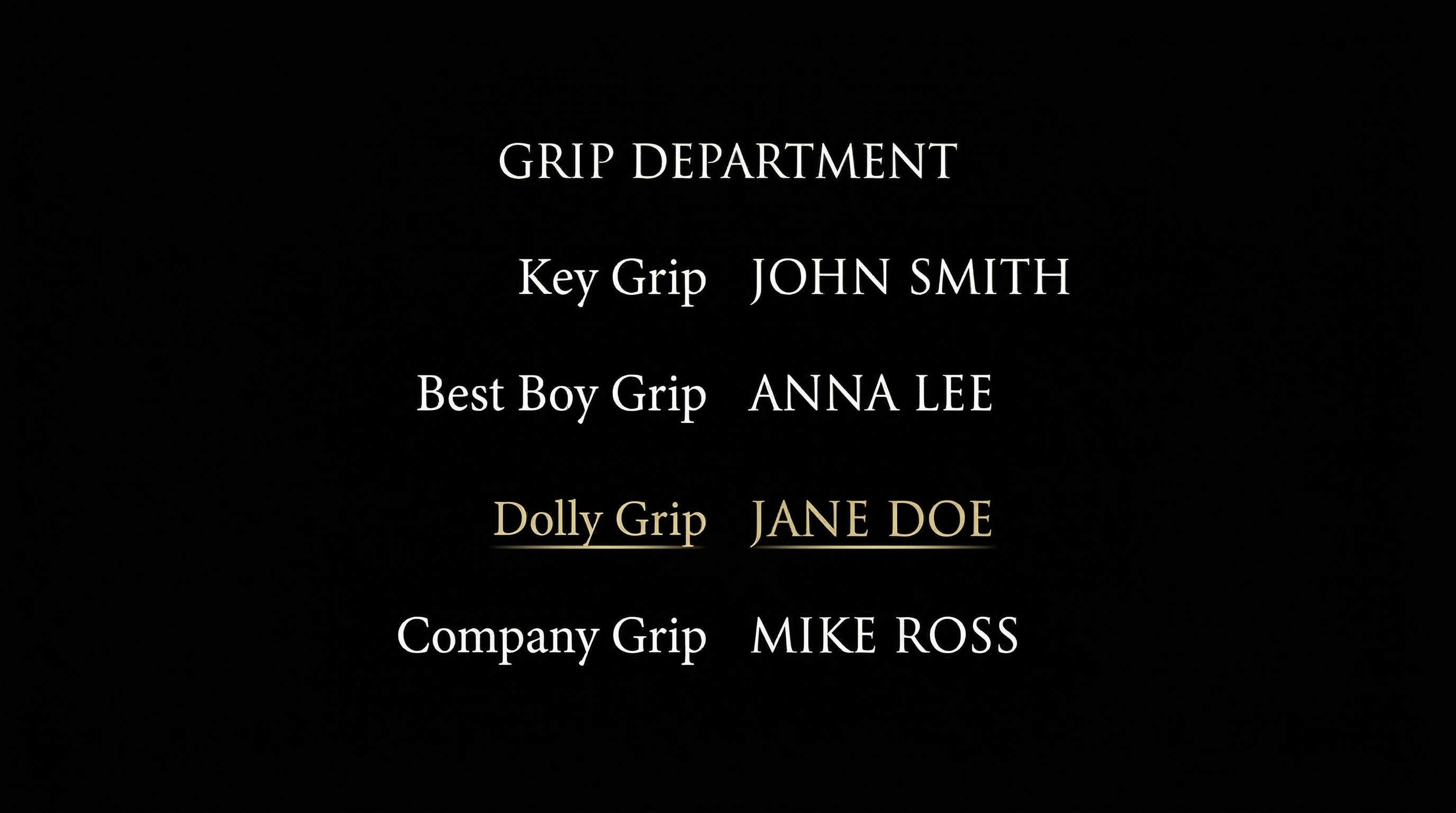
The dolly grip’s position directly after the Best Boy Grip reflects the specialized, skilled nature of the role within the department hierarchy. On productions that use a dolly extensively — any feature with significant camera movement — the dolly grip’s credit is guaranteed and positioned prominently within the grip block.
On a feature film, the grip department block typically appears near the electrical department block, both placed in the below-the-line crew section of the crawl. See the film credits format and order guide for the full department sequence.
Single Card vs. Scroll
Like most grip crew members below department head level, the dolly grip receives a shared scroll credit in the grip department block. The Key Grip occasionally receives a solo card or a prominent placement in a “Key Crew” section, but the dolly grip, Best Boy, and remaining crew appear in the scrolling crawl.
How to credit a dolly grip correctly
Exact Format, Variations, and Guild Requirements
The standard screen credit format:
Dolly Grip ........................ JANE DOEOr in a department block layout:
GRIP DEPARTMENT

Key Grip
JOHN SMITH

Best Boy Grip
ANNA LEE

Dolly Grip
JANE DOE

Company Grip
MIKE ROSS
Accepted title variations:
- Dolly Grip — the standard title on nearly all productions
- Camera Dolly Grip — occasionally used on productions that want to clarify the role for non-industry audiences; rare on screen
- Dolly Operator — not a standard credits title; avoid this in the end crawl
Guild requirements: On IATSE-signatory productions, the dolly grip works under IATSE Local 80 (Grips) in Los Angeles. The union does not mandate a specific credit wording, but the production is contractually obligated to provide a screen credit using the agreed title. Failure to credit covered crew members is a contract violation.
Multiple roles: On low-budget productions where one person performs both dolly and general grip duties, credit them in the role they primarily performed:
Dolly Grip / Key Grip
JOHN DOE
If the production used no dolly, do not include a dolly grip credit. For correct formatting of all below-the-line credits, see how to format film credits.
Dolly grip vs key grip
Two Distinct Roles, One Department
The Key Grip and the dolly grip are not interchangeable. The confusion comes from the fact that both work within the grip department. Here is the actual breakdown:
| Dolly Grip | Key Grip | |
|---|---|---|
| Scope | Camera dolly and movement | Entire grip department |
| Reports to | Key Grip | DP (Director of Photography) |
| Crew managed | None (specialist, not a department head) | Best Boy Grip, dolly grip, all grips |
| Primary focus | Executing camera moves precisely | Light control, rigging, camera support overall |
| Credit position | 3rd in grip department block | 1st (department head) |
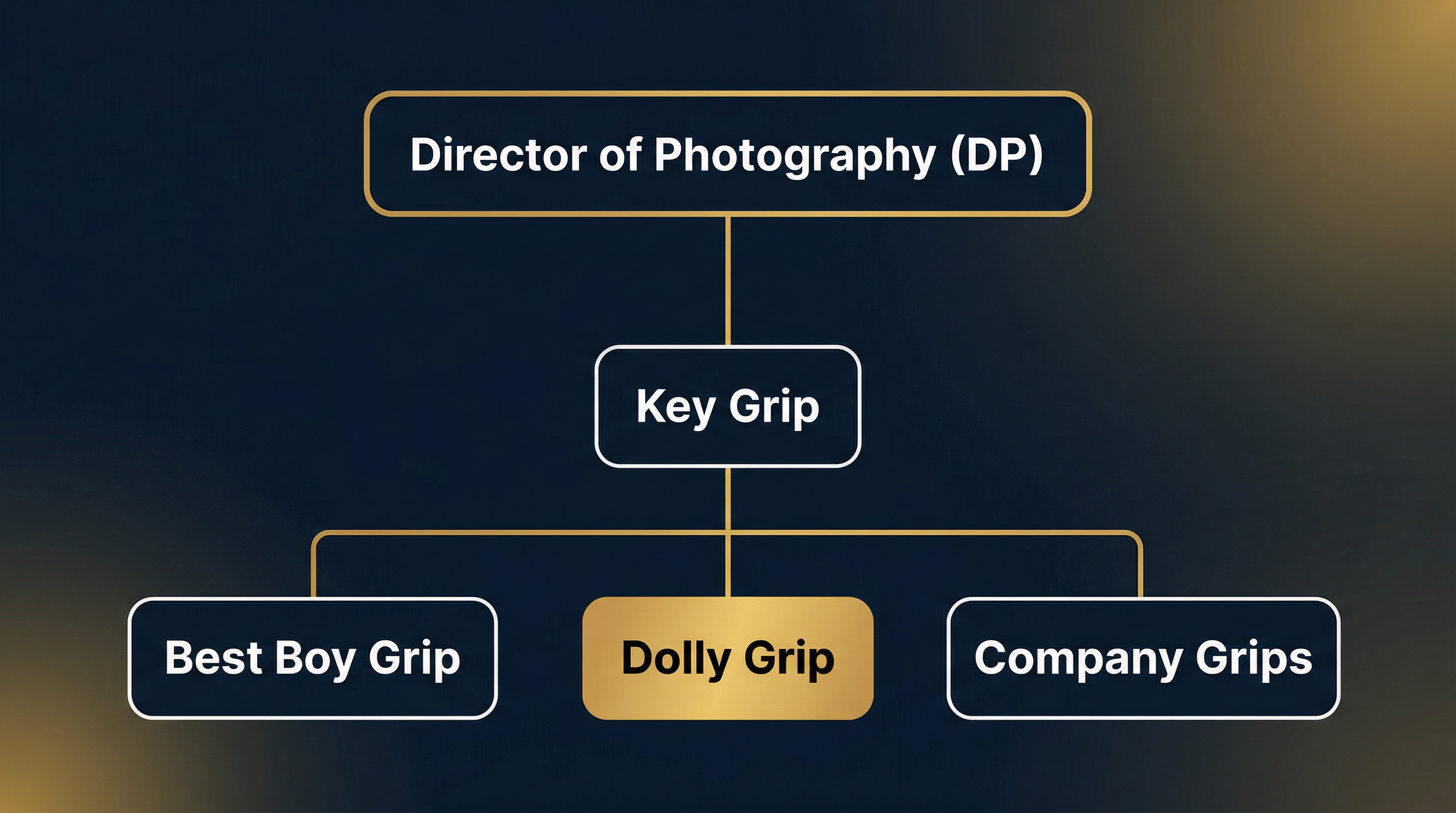
The Key Grip is a department head responsible for the full grip scope: flags, frames, diffusion, rigging, camera support, and the dolly. The dolly grip specializes within that scope — exclusively operating the dolly. On larger productions, there is no overlap. On smaller shoots, the Key Grip may also operate the dolly.
Their department relationship is parallel to the gaffer and Best Boy Electric relationship in the electrical department — except within the grip department hierarchy.
How to become a dolly grip
Career Path and Progression
Most dolly grips begin as general grips (“day players”) or production assistants with an interest in the grip department. The progression looks like this:
- Grip / Day Player — general set experience, loading/unloading, carrying equipment
- Company Grip — consistent set work, learning dolly prep and track laying
- Best Boy Grip — coordinating the crew, coordinating truck and equipment
- Dolly Grip — lateral move into specialization, not necessarily linear from Best Boy
The dolly grip skill set is distinct enough that many grips pursue it as a career specialization rather than a stepping stone to Key Grip. Experienced dolly grips on high-movement productions — musicals, action films, long-take dramas — are in consistent demand.
Union membership through IATSE Local 80 in Los Angeles (or the regional IATSE locals in New York, Chicago, and other markets) significantly expands the range of available productions and standardizes rates and working conditions.
Notable dolly grips in film history
The Professionals Behind Iconic Camera Moves
Dolly grips rarely receive the press that directors and cinematographers do, but their work is inseparable from cinema’s most memorable sequences.
-
Jett Evans — a working dolly grip with documented career experience on professional productions. Evans has discussed the technical and creative aspects of the role, including the grip’s real-time communication with the camera operator during tracking shots.
-
Undocumented legacy of Jaws 3 (1983) — a persistent reference in online film crew communities (“assistant dolly grip jaws 3”) points to the way lower-tier credits on genre productions of the 1980s documented a generation of working grips whose careers spanned decades of studio filmmaking.
-
The Coen Brothers’ long-take collaborations with cinematographer Roger Deakins demanded extraordinary dolly precision — particularly in No Country for Old Men (2007) and True Grit (2010), where dolly moves define scene geometry without calling attention to themselves.
Sources and Further Reading
Official resources:
- IATSE Local 80 — the union representing grips, including dolly grips, in Los Angeles
- ScreenSkills — Dolly Grip / Camera Grip Skills — UK industry skills checklist for the role
Further reading:
- Wikipedia — Dolly Grip — concise definition with IATSE context
- HowStuffWorks — What Does a Dolly Grip Do? — overview of the track-laying and push/pull process
Related EndCreditsPro guides:
- Film Credits Format and Order Guide
- All Film Crew Roles
- Key Grip — Role and Credits (coming soon)
- Gaffer — Role and Credits
- IATSE Compliance Guide
Create Professional Credits with EndCreditsPro
Getting the dolly grip in the right position — below Best Boy, above Company Grip, within the grip department block — is not guesswork. EndCreditsPro formats your end credit crawl with the correct department order, role hierarchy, and guild-compliant layout automatically.