What Is Craft Services in Film?
At the 2024 Golden Globes, Colin Farrell interrupted his own speech to shout out Carolina Cadmilema — his craft services worker — to a standing ovation. Nobody is nominated for Craft Services. They just keep the entire crew alive.
Craft services (also called “crafty”) is the department on a film, television, or commercial production responsible for providing cast and crew with snacks, beverages, and other between-meal sustenance throughout the shooting day. Unlike catering — which handles formal sit-down meals — craft services is available continuously, from the first crew call to the final wrap.
The term comes directly from the union structure of Hollywood. Craft services personnel are there to serve the crafts — the skilled technical departments (camera, grip, electric, hair, makeup, props, wardrobe) that make up the production crew. The name predates the modern usage: when the IATSE first organized film sets in the early 20th century, “the crafts” referred to any specialized skilled labor, and the people keeping those departments fed became “craft services.”
Craft services workers report to the unit production manager (UPM) or line producer for budgeting and scheduling. On larger productions, there is a dedicated Craft Services Coordinator and a team of one or more assistants. On micro-budget shoots, a production assistant often doubles as the crafty person.

What does craft services do on a film set?
The Day-to-Day Job of a Craft Services Coordinator
The job sounds simple — buy snacks, set up a table, keep the coffee hot. In practice, it requires catering knowledge, logistical precision, and the interpersonal skills of a therapist.
Daily responsibilities include:
- Setting up the craft services station before crew call — typically by 6:00–6:30 AM
- Maintaining coffee, hot water, and non-caffeinated beverages throughout the day
- Stocking and restocking snacks: fresh fruit, packaged nuts, chips, granola bars, cheese, crackers, vegetables with dip
- Setting up a secondary “satellite” station near distant or hard-to-access shooting locations so crew don’t have to leave the set
- Accommodating dietary restrictions and allergies (vegan, gluten-free, nut-free) across the full crew list
- Monitoring crew energy levels during extended days — 12- and 14-hour shoots require active management
- Maintaining cleanliness, food safety standards, and waste disposal at the crafty station
- Coordinating with the caterer on timing so crafty complements meals, not competes with them
Veteran craft services professionals know their crews personally. As Jediah, an experienced crafty worker quoted in The Bite, put it: “I’m constantly reading the room, figuring out what people want and need. There’s a big difference in feeding people who are hungry versus feeding people who are bored.”

On larger productions, craft services may also manage a kit of on-set supplies for departments — electrical tape, hand sanitizer, pain relievers, sunscreen — that departments run out of during long days. The IATSE’s jurisdictional rules explicitly allow craft services laborers to cross departmental lines to assist camera, grip, electric, and set dressing crews with non-technical tasks.
What is the difference between craft services and catering?
Craft Services vs. Catering: What Every Producer Needs to Know
These two departments are distinct and both are contractually required on union productions. Confusing them leads to scheduling mistakes and labor violations.
| Craft Services | Catering | |
|---|---|---|
| What they provide | Snacks, beverages, between-meal food | Full hot meals (breakfast, lunch, dinner) |
| When available | Continuously, all day | At designated meal breaks only |
| Frequency | Always open | Every 6 hours per union rules |
| Format | Self-service table or station | Sit-down or buffet meal service |
| Budget line | Separate crafty budget | Catering contract |
| Union requirement | IATSE craft services local | IATSE catering local (or separate contractor) |
Under IATSE agreements and SAG-AFTRA contracts, producers are required to provide a meal break every six hours. Craft services does not count as a meal — a granola bar cannot substitute for a hot lunch. If the caterer is late or the meal break is missed, the production owes meal penalty payments to the crew.
On low-budget and student productions, the distinction is often collapsed — craft services feeds everyone all day, and a catered lunch may be as simple as pizzas from a local restaurant. On studio-level productions, the two departments are entirely separate, with different IATSE locals, different supervisors, and separate call times.
Where does craft services appear in film credits?
Craft Services Credit Placement in End Credits
Craft services does not appear in opening credits. Like most support departments, it is exclusively credited in the end crawl.
In the end credits, craft services appears under the Production Staff or Set Operations section of the scroll — typically in the latter half of the crew credits, after camera, grip, electric, sound, and art department credits, and near other support functions like transportation and locations.
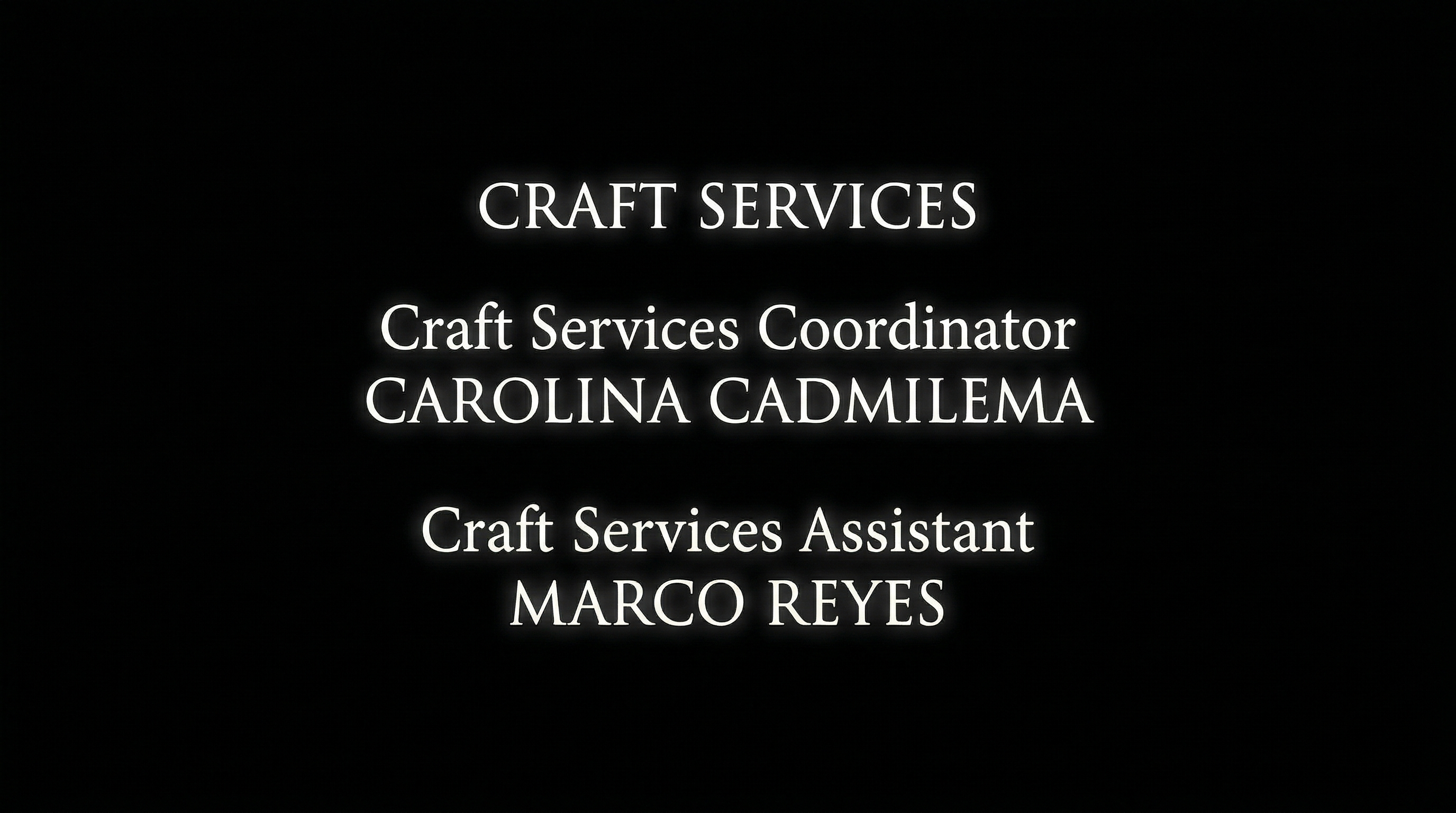
Standard credit block structure:
CRAFT SERVICES

Craft Services Coordinator    CAROLINA CADMILEMA
Craft Services Assistant      FIRST NAME LAST NAME
On smaller productions with a single person running crafty, the credit is often simply:
Craft Services FULL NAMETitle variants you will see in actual productions:
- Craft Services — most common
- Craft Service — singular form, used interchangeably
- Crafts Service — less common, reflects older IATSE terminology
- Key Craft Services — used when there is a lead with subordinates
Craft services typically appears as a scroll line in the main crawl — not a single card. On large studio productions, the department may have three to five people credited across multiple lines.
How to credit craft services correctly
Formatting the Craft Services Credit
The credit should reflect the production’s actual personnel structure. There is no DGA or WGA requirement governing the craft services credit — it is governed by IATSE collective bargaining agreements and, practically, by industry convention.
For a single person:
Craft Services JESSICA HALLFor a department with a coordinator and assistants:
CRAFT SERVICES

Craft Services Coordinator    JESSICA HALL
Craft Services Assistant      MARCO REYES
Common crediting errors to avoid:
- Spelling errors: “Craft Servcies” or “Crafts Services” — both appear in real credits and both are wrong
- Wrong title inflation: calling a PA who ran crafty a “Coordinator” — this matters on union productions where title determines pay
- Omitting the role: forgetting to credit craft services entirely — this happens more often than it should on low-budget films and creates hard feelings with crew members who worked long days
IATSE note: Craft services is represented by IATSE, but the specific local varies by location. In Los Angeles, craft services falls under IATSE Local 80 (Studio Grips) by historical precedent. In New York, it may fall under Local 52 or be handled by a different local depending on the production agreement. Always check the applicable collective bargaining agreement for the production territory.
Craft services salary & day rates
What Does a Craft Services Coordinator Earn?
Craft services rates are governed by IATSE tier agreements and vary significantly by production size and location.
IATSE Low-Budget Theatrical tiers (approximate):
| Production Budget | Craft Services Rate |
|---|---|
| Under $500K | Below-scale negotiated rate |
| $500K–$1.5M | Low-budget tier minimum (~$250–$350/day) |
| $1.5M–$5M | Mid-tier minimum (~$350–$450/day) |
| Full scale | Scale rate per local agreement |
On large-scale studio features and episodic television, craft services coordinators with strong reputations earn $500–$700+ per day. In major markets (Los Angeles, New York), experienced craft services workers with established sets of preferred suppliers and deep production relationships command the top of the range.
Craft services assistants typically earn 60–70% of the coordinator rate.
Kit rental is an additional income stream: craft services coordinators often own their own equipment (coffee urns, warming trays, coolers, folding tables) and charge a daily kit rental fee on top of their labor rate — typically $50–$150/day depending on the equipment package.
How to budget for craft services
Craft Services Cost: What Productions Typically Spend
Craft services is a line item in the production budget, separate from catering. Budget expectations vary widely:
- Student/micro-budget films: $50–$150/day out of pocket — water, coffee, basic snacks from a wholesale club
- Low-budget independent features: $100–$300/day including a crafty person’s time
- Mid-range features and episodic TV: $300–$600/day, often with a dedicated coordinator
- Studio features and premium cable/streaming: $500–$1,500+/day, full kit, dietary-specific options
Rules of thumb from experienced producers:
- Budget approximately $10–$20 per crew member per day for crafty supplies
- Always have more coffee than you think you need
- Dietary accommodations (vegan, gluten-free, nut allergies) are no longer optional — budget for them from day one
A Reddit commenter on r/Filmmakers captured the cost-benefit calculation precisely: “If you are making a no budget short relying on favors… crafty is your number 1 thing to make people happy all day. Get your waters, redbulls, soda, coffee, veggie platter, chips, a bit of candy, and then plan your actual meals.”
How to get into craft services
Career Path: Getting Started in Craft Services
Craft services is one of the more accessible entry points into the film industry — it requires no formal film school training and the skills transfer directly from food service, event catering, and hospitality work.
Common entry paths:
-
Production assistant (PA) route: Many craft services careers start by volunteering to handle crafty on student or low-budget sets. A PA who consistently delivers reliable, good-quality food builds a reputation that generates repeat bookings.
-
Food service background: Professional caterers, restaurant workers, and event staff bring directly applicable skills — food safety, volume purchasing, dietary accommodation, fast setup under pressure.
-
IATSE apprenticeship: In union markets, formal entry requires going through the IATSE apprenticeship or permit system. Contact the relevant local for the production territory to understand the requirements.
What production companies look for in a craft services hire:
- Reliability — arriving before the crew and staying until the end
- Knowledge of dietary restrictions and food safety
- Physical stamina — the job involves early call times, heavy lifting, and long days
- Discretion and professionalism on set
- An established supplier network (for coordinator-level roles)
Where does craft services fit vs. other crew roles?
Craft Services vs. Catering Coordinator
Craft services and the catering/craft coordinator roles are distinct but sometimes confused on smaller productions.
The catering coordinator manages the contracted catering company that delivers hot meals. On large productions, this role sits within the production department. The craft services coordinator operates independently — buying supplies, setting up their own station, and managing their own team.
In some regional markets, a single “Craft Services and Catering” coordinator handles both. This is common on commercials and music videos where the scale doesn’t justify two separate departments. When credited, this role typically appears as:
Craft Services & Catering FULL NAMENotable craft services professionals
The People Behind the Table
Craft services workers are rarely profiled, but their reputation travels fast within the industry. A good crafty person gets rehired production after production, accumulating long careers through word of mouth.

Carolina Cadmilema — the craft services worker Colin Farrell thanked by name at the 2024 Golden Globes while accepting the award for The Banshees of Inisherin. Her reputation for personal attention — tracking individual cast members’ preferences and health needs through a grueling winter shoot in New York — exemplifies what separates professional craft services from a table of chips.
Jediah (quoted in The Bite, New Mexico) represents the regional side of the industry: “Whether a craft services professional is working on a film with a budget of $100 million or $1 million, whether they are cooking out of a commercial kitchen or a golf cart, they are constantly on the move to keep morale and energy high.”
Sources & Further Reading
- IATSE Official Website — union structure and local agreements for craft services personnel
- Wikipedia: Craft service — historical and union context
- StudioBinder: What is Craft Services on a Movie Set — overview with IATSE tier rates
Create Professional Credits with EndCreditsPro
Craft services keeps your crew running. Your end credits should do the same for your production’s reputation. EndCreditsPro auto-formats guild-compliant end credits — getting the department order, title formatting, and scroll timing right for broadcast delivery. Generate your credits in minutes →
See also: Film Crew Roles hub · What is a Line Producer? · What is a Gaffer? · What is an Associate Producer? · IATSE Compliance Guide · Film Credits Format & Order Guide